
In an era where digital technologies like 3D rendering, virtual reality (VR), and Building Information Modeling (BIM) have become standard tools, custom scale models continue to play an essential role in project visualization and communication. A physical scale model transforms complex concepts into realistic, tangible representations that are easy to understand, making them invaluable across many industries.
From architecture and real estate to shipbuilding and industrial engineering, scale models help businesses present ideas, improve decision-making, and create memorable experiences for clients and stakeholders.
In this blog, we'll explore 10 industries that benefit the most from custom scale models and why they remain an indispensable tool in today's world.
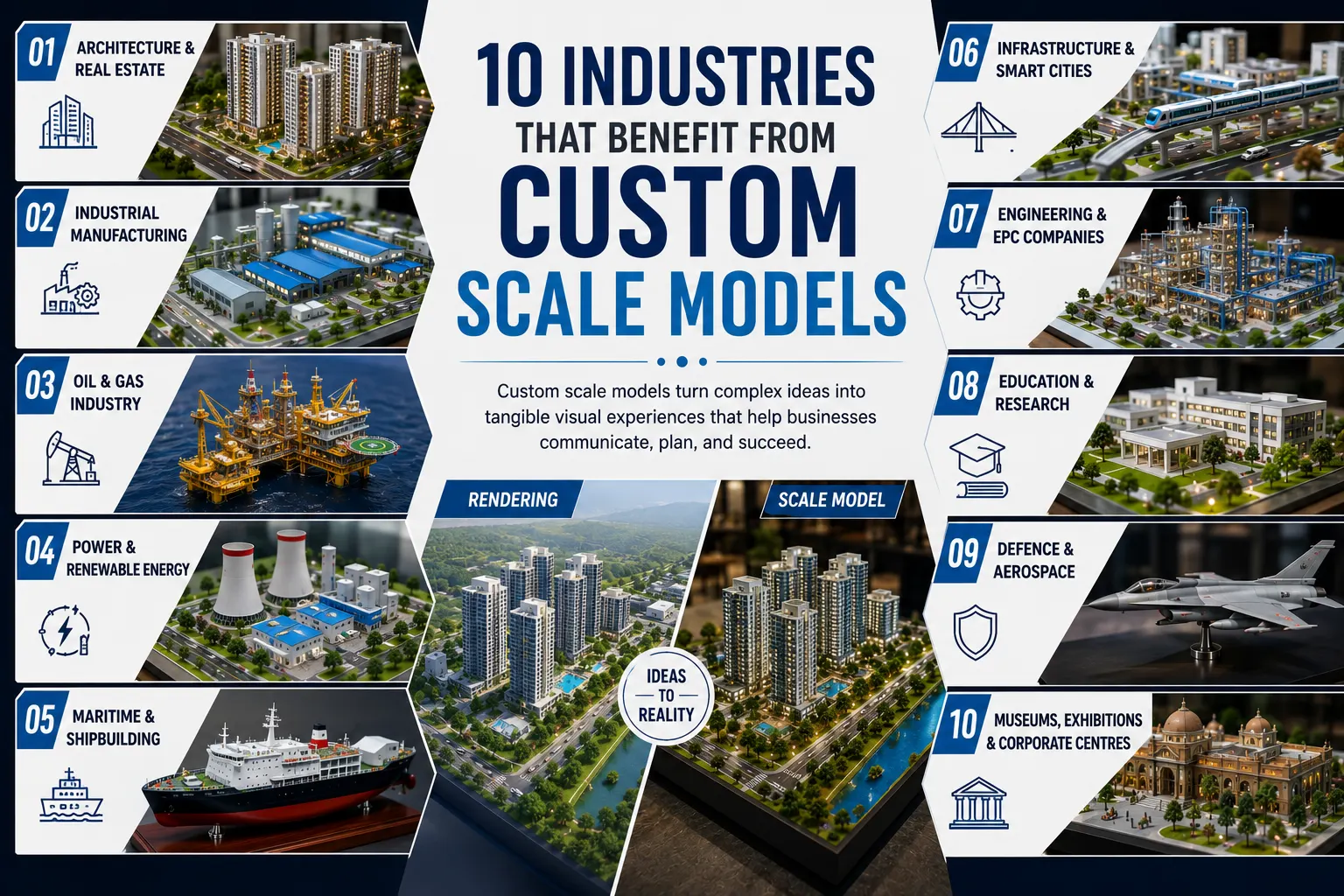
Architecture & Real Estate
The architecture and real estate industry is one of the largest users of custom scale models.
Architectural scale models allow developers, architects, and clients to visualize buildings long before construction begins. They accurately represent the design, surrounding landscape, roads, parking areas, and amenities, making it easier to understand the project's overall layout.
Benefits
- Better project visualization
- Improved client presentations
- Faster property sales
- Enhanced marketing displays
- Increased buyer confidence
Scale models are commonly displayed in sales galleries, corporate offices, and property exhibitions to help potential buyers make informed decisions.
Industrial Manufacturing
Industrial projects often involve highly complex layouts, machinery, pipelines, storage tanks, and production systems.
A custom industrial scale model simplifies these technical details into an easy-to-understand representation.
Industries use these models for:
- Plant planning
- Investor presentations
- Factory demonstrations
- Safety training
- Project approvals
They provide a clear understanding of industrial operations without requiring technical expertise.
Oil & Gas Industry
Oil refineries, petrochemical plants, offshore platforms, and LNG terminals contain thousands of interconnected components.
Physical scale models help companies communicate these complex facilities effectively.
Applications include:
- Refinery presentations
- Offshore platform demonstrations
- Training programs
- Government approvals
- Exhibition displays
These models provide a realistic overview of large-scale energy infrastructure.
Power & Renewable Energy
Power generation projects require clear visualization during planning and presentations.
Custom models are widely used for:
- Thermal power plants
- Solar farms
- Wind energy projects
- Hydroelectric plants
- Waste-to-Energy facilities
- Nuclear plants
Scale models help explain energy generation processes and demonstrate project layouts to investors, government agencies, and visitors.
Maritime & Shipbuilding
Shipbuilding companies frequently commission custom ship models for both technical and promotional purposes.
These models accurately replicate:
- Cargo ships
- Tankers
- Naval vessels
- Offshore support vessels
- Cruise ships
- Tug boats
- Luxury yachts
Ship models are used for exhibitions, maritime museums, corporate offices, and client presentations.
Infrastructure & Smart Cities
Large infrastructure projects involve multiple interconnected systems that can be difficult to understand from drawings alone.
Custom scale models simplify projects such as:
- Smart cities
- Metro rail networks
- Airports
- Bridges
- Highways
- Railway stations
- Ports
These models help government agencies, planners, and investors visualize future developments and make better planning decisions.
Engineering & EPC Companies
Engineering, Procurement, and Construction (EPC) companies rely on scale models to communicate technical concepts more effectively.
Applications include:
- Engineering design reviews
- Equipment layouts
- Manufacturing facilities
- Process plants
- Utility systems
Scale models reduce communication gaps between engineers and non-technical stakeholders while supporting project planning and execution.
Education & Research
Educational institutions use scale models to simplify learning through visual and interactive demonstrations.
They are commonly used in:
- Engineering colleges
- Architecture schools
- Maritime academies
- Technical universities
- Research laboratories
Students gain a better understanding of complex structures and systems through hands-on observation.
Defence & Aerospace
Defence organizations use precision scale models for planning, exhibitions, and training.
Examples include:
- Military bases
- Naval fleets
- Aircraft
- Missile systems
- Radar installations
- Defence infrastructure
These models help explain strategic concepts and technical systems while supporting educational and operational activities.
Museums, Exhibitions & Corporate Experience Centres
Museums and corporate experience centers use custom scale models to engage visitors through realistic visual storytelling.
Applications include:
- Historical ship displays
- Heritage monuments
- Industrial exhibitions
- Company experience centres
- Trade fairs
- Product launches
Scale models attract attention, encourage interaction, and leave a lasting impression on visitors.
Why Physical Scale Models Continue to Matter
Even with advances in digital visualization, physical scale models offer several unique advantages:
- Realistic three-dimensional representation
- Better understanding of complex projects
- Improved stakeholder communication
- Powerful marketing and sales tool
- Interactive learning experience
- Professional exhibition display
- Long-lasting presentation asset
Unlike digital images viewed on a screen, physical models allow viewers to experience a project from every angle, creating a stronger emotional connection and greater confidence.
Choosing the Right Scale Model Partner
A high-quality scale model requires technical expertise, precision craftsmanship, and attention to detail.
When selecting a model-making company, consider:
- Industry experience
- Portfolio of completed projects
- Material quality
- Accuracy and detailing
- Ability to customize models
- Timely project delivery
- Professional finishing
Choosing an experienced partner ensures your model accurately represents your vision while meeting the highest quality standards.
Why Choose Jagtap Miniature Scale Model Making Company?
At Jagtap Miniature Scale Model Making Company, we specialize in designing and manufacturing premium custom scale models for clients across diverse industries. From architectural developments and industrial facilities to ship models and engineering projects, our team combines advanced techniques with skilled craftsmanship to create models that are both visually stunning and technically accurate.
Our models help businesses communicate ideas effectively, enhance presentations, support project planning, and create memorable experiences for clients, investors, and stakeholders.
Frequently Asked Questions About Custom Scale Models
How does a physical scale model help in industrial or engineering project planning?
Physical scale models simplify complex technical layouts—such as pipelines, machinery, and production systems—into tangible, easy-to-understand representations, allowing engineers and stakeholders to visualize projects, identify potential design flaws, and improve decision-making before construction begins.
What industries can benefit from custom scale models?
Custom scale models are essential for a wide range of industries including architecture and real estate, oil and gas, power and renewable energy, maritime and shipbuilding, industrial manufacturing, infrastructure, engineering, defence, and educational institutions.
How do physical models compare to digital visualization (like BIM or 3D rendering)?
While digital tools are useful, physical models offer a unique, realistic three-dimensional experience that creates a stronger emotional connection, supports better spatial understanding for non-technical stakeholders, and serves as a long-lasting, tangible presentation asset for high-stakes meetings.
Can you customize models based on specific industrial requirements or safety standards?
Absolutely; we specialize in precision craftsmanship and can customize models to accurately replicate technical machinery, safety zones, utility systems, and complex infrastructure to meet the specific documentation and approval needs of your industry.
Are your scale models suitable for exhibitions and corporate experience centers?
Yes, our models are designed to be high-impact display pieces perfect for exhibitions, trade fairs, museums, and corporate experience centers, helping to attract visitor attention and facilitate effective visual storytelling.
Conclusion
Custom scale models continue to be one of the most powerful visualization tools available today. Whether you're developing a residential township, planning an industrial facility, building a vessel, or showcasing a smart city, a professionally crafted scale model transforms complex ideas into clear, engaging, and impactful presentations.
Across industries, physical scale models improve communication, support decision-making, strengthen marketing efforts, and bring ambitious projects to life.
If you're looking for a trusted partner to create a custom scale model tailored to your project, Jagtap Miniature Scale Model Making Company is ready to turn your vision into reality with precision, creativity, and exceptional craftsmanship.